
Irrigation is where a landscaping project’s real value shows up months and years later, not on installation day — and it’s also the single category where things go most wrong when it’s treated as an afterthought. A sprinkler system with the wrong spacing wastes water and leaves dry patches next to soggy ones. A drip system that isn’t zoned by plant water need ends up either underwatering the plants that need more or overwatering the ones that need less. Both are common, preventable mistakes, and both are more expensive to fix later than to get right the first time.
Example image for illustration — not an actual completed Rooted Landscape Co. project.
What’s Actually Included?
An irrigation project covers six core areas: system design and zoning, drip/micro-irrigation installation, sprinkler installation and repair, seasonal adjustment, backflow protection, and diagnostics/repair on existing systems.
- System design and zoning. Grouping plants and turf by actual water need — a xeriscape bed of established natives, a small turf area, and a young tree all have different watering needs, and a well-designed system waters each zone on its own schedule instead of treating the whole yard the same.
- Drip and micro-irrigation installation. For beds, shrubs, and trees, drip and micro-spray systems put water directly at the root zone instead of spraying it into the air, where wind and heat can evaporate a meaningful amount of it before it ever reaches the soil. New Mexico State University Extension notes drip and subsurface irrigation can cut water use by 30-50% compared to overhead sprinklers for the same coverage.
- Sprinkler system installation and repair. Where turf areas call for sprinklers, correct head spacing and coverage matters as much as the equipment itself — overlapping coverage gaps are one of the most common, and most avoidable, installation mistakes.
- Seasonal adjustment. Watering needs change dramatically between a Las Cruces summer and winter, and a system that isn’t adjusted seasonally either wastes water or under-waters plants during the wrong stretch of the year.
- Backflow assemblies and cross-connection protection. Any system tied into the municipal water line needs a properly installed backflow prevention device to keep irrigation water from siphoning back into the drinking water supply. The City requires this under its Backflow Prevention Ordinance (Ordinance 1694), enforced through Las Cruces Utilities’ Backflow Prevention Program — call 575-528-3551 if you need to confirm an assembly’s compliance status.
- Diagnostics and repair. Leaks, clogged emitters, failed valves, and dead zones on an existing system — new installation isn’t the only thing this covers.
Should You Use Drip Irrigation or Sprinklers in Your Las Cruces Yard?
Both, usually — just in different parts of the yard. Most well-designed Las Cruces properties run drip/micro-spray for beds and trees, and sprinklers for turf, rather than picking one system for the whole property.
| Factor | Drip / Micro-Spray | Sprinklers |
|---|---|---|
| Best for | Beds, shrubs, trees | Turf / lawn areas |
| Water loss to evaporation | Low | Higher, especially midday |
| Coverage style | Point-source, at the root | Continuous, overlapping zones |
What’s the Most Common Irrigation Design Mistake We See?
Using one system’s watering logic on the other. A drip zone run on a sprinkler’s short, frequent schedule doesn’t get water deep enough to encourage strong roots. A sprinkler zone watered like a drip zone leaves turf stressed. The fix is designing the schedule around which type of system is actually in the ground, not applying one watering philosophy everywhere.
What Are the City of Las Cruces Watering Rules for Irrigation Systems?
No outdoor watering on Mondays, assigned days by address, and seasonal time limits — and these rules apply to automated systems too, not just hose watering.
| Day | Watering Status |
|---|---|
| Monday | No outdoor watering — citywide, every address |
| Tuesday, Thursday, Saturday | Even-numbered addresses only |
| Wednesday, Friday, Sunday | Odd-numbered addresses only |
| April–September, any allowed day | Before 10 a.m. or after 6 p.m. only — the hours when watering is most effective anyway |
Do I Need a Smart Controller to Stay Compliant?
No, but it makes compliance much easier without under-watering anything. A smart, weather-based controller with correctly zoned programming keeps a short Tuesday window for drought-adapted natives from getting stretched to also cover a young tree that needs more. An estimated 42% of U.S. households with irrigation now use a smart or weather-based controller in place of a fixed timer, and switching typically cuts water use by roughly 15-30% compared to a static schedule (2026 industry data, Instant Interior AI State of Landscaping report).
Does Your Property Run on City Water, Well Water, or Ditch Irrigation?
Not every Las Cruces-area property is on City water, and the design has to match the actual source. We confirm the real water source and system capacity on every property before designing or repairing irrigation, rather than defaulting to a city-water design and hoping it holds up.
- Private well systems (common in Organ and Dripping Springs) — pressure and flow rate are set by what the well can actually deliver, not a municipal standard.
- Acequia / ditch-irrigation history (Doña Ana’s historic district, plus Vado, Fairacres, Anthony, and La Mesa) — older infrastructure, unusual drainage patterns, or soil shaped by decades of ditch-fed farming.
- Local utility water (Talavera) — served by its own utility rather than City of Las Cruces municipal water, which changes pressure and scheduling assumptions.
Is Rainwater Harvesting Legal in Las Cruces, and Is It Enough on Its Own?
Legal and encouraged, but it’s a supplement, not a substitute for irrigation. Las Cruces gets roughly 9 inches of rain a year, concentrated in a few summer months, so a harvesting system alone won’t carry a yard through summer the way an irrigation system does.
- What’s allowed: barrels, cisterns, and ground-level swales that capture roof runoff — a genuine, low-cost supplement, particularly during the July-September monsoon when a single storm can produce more usable water than several scheduled waterings.
- Where it earns its keep: reducing how much irrigation demand you’re pulling from the municipal supply, especially for xeriscape beds that don’t need much water to begin with.
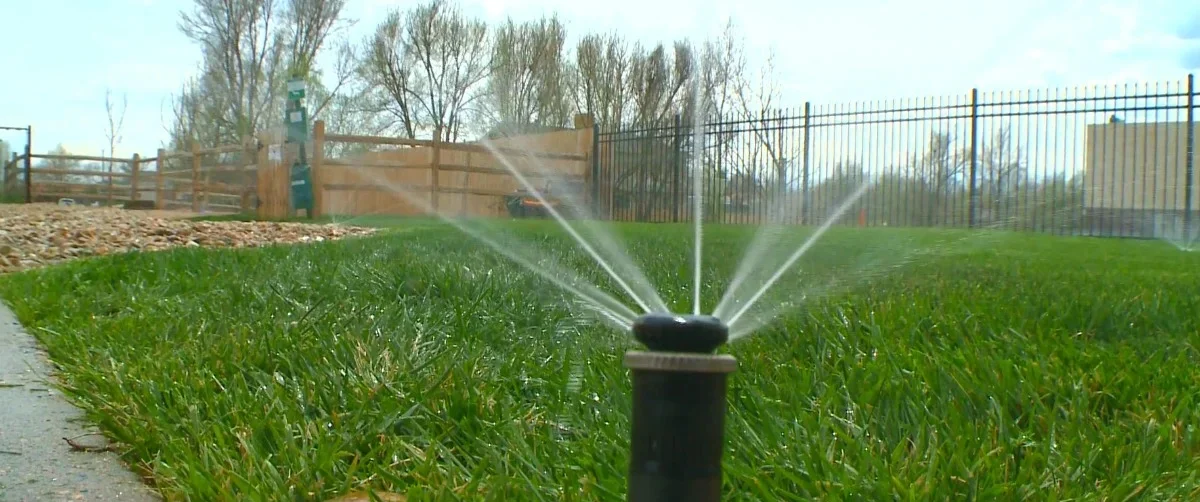
Example image for illustration — not an actual completed Rooted Landscape Co. project.
Common Irrigation Problems We Diagnose and Fix
Most irrigation service calls come down to four recurring problems: dry/soggy patches, visible leaks, dead zones, and new plantings that struggle despite watering. Irrigation work has a wider range of outcomes than almost any other part of landscaping — done well, it’s the thing that makes everything else in a yard actually thrive with minimal water waste; done poorly, it can cause real damage. Incorrect spacing or timing on a new sod installation, for example, can leave large areas of turf dead within a season, and by the time it’s obvious something’s wrong, the fix usually costs more than getting the original installation right would have.
Why Do Some Areas of My Lawn Stay Dry While Others Are Soggy?
Almost always a head-spacing or coverage problem, or a zoning issue where different water needs share one schedule. It’s a fixable design problem, not something to solve by just running the system longer.
Beyond that specific case, the problems that actually bring people to call an irrigation company, in our experience, are rarely mysterious once you’re looking at the system directly:
- Dry patches next to soggy ones. Almost always a head-spacing or coverage problem, or a zoning issue where different water needs are on the same schedule.
- A system that’s visibly leaking. Usually a cracked fitting, a damaged supply line, or a valve that isn’t seating properly.
- A zone that doesn’t come on at all. Often a failed valve, a wiring break, or a controller programming issue — three different causes with three different fixes.
- New sod or plants struggling despite enough watering. Almost always a scheduling or depth problem, not a sign the plants need more total water.
If a system isn’t behaving the way it should, that’s worth a real diagnostic visit rather than guesswork, since the underlying cause determines the fix.
What Does an Irrigation Audit Actually Check?
A real audit checks four things: pressure/flow, head and emitter spacing, leaks or worn parts, and whether the controller program still matches what’s actually planted.
- Confirming actual water pressure and flow at the source.
- Checking each zone’s head or emitter spacing against its actual coverage area.
- Identifying leaks or worn components.
- Comparing the controller’s current program against what the plants in each zone actually need this season.
For a system that’s been running the same program for years without anyone checking it — which describes a lot of the older systems in University Hills, Las Alturas, and Mesilla Park — an audit is usually the fastest way to find out whether the water bill and the plant health problem are actually the same root cause.
Do You Handle Irrigation for Commercial Properties and HOAs?
Yes — same principles, larger scale. Commercial properties and HOA common areas carry their own irrigation considerations: larger zone counts, more complex controller programming, and often a mix of turf and xeriscape areas that need to be zoned independently, usually with more accountability to a board or property manager who needs the system to run predictably. See our Commercial & HOA Landscaping page for more on how we handle larger properties.
How Much Does Irrigation Installation or Repair Cost in Las Cruces?
A full sprinkler or drip system installation runs roughly $2,400 on average (based on current national cost-guide data: Homeyou, Homeblue, LawnStarter, and Angi’s 2026 guides) — though the real number depends on:
| Cost Factor | Why It Matters |
|---|---|
| System type | Drip, sprinkler, or a mix of both changes material and labor needs |
| Size and layout | More area and more complex shapes mean more pipe, heads, and labor |
| Number of zones | Each zone needs its own valve and controller programming |
| New construction vs. retrofit | Retrofitting into an existing landscape is usually more labor-intensive than new-build installation |
Repair costs vary even more by cause: a single valve or head repair is a small job, while re-zoning an incorrectly designed system is closer to a partial reinstall. We don’t quote a number over the phone for anything beyond the simplest repair — a site visit tells us what’s actually there, and you get a written estimate before any work starts.
Frequently Asked Questions
How much water can a drip irrigation system actually save compared to sprinklers?
Efficient drip and subsurface irrigation can reduce water use by roughly 30-50% for the same plant coverage compared to overhead sprinklers, largely because less water is lost to evaporation and overspray.
Does my irrigation system need to follow the City’s watering schedule?
Yes — the City’s outdoor watering ordinance (no watering Mondays, assigned days by address, seasonal time restrictions) applies regardless of whether watering is manual or automated. A properly zoned system with a working controller makes it much easier to stay within that schedule without under-watering.
Why do some areas of my lawn stay dry while others are soggy?
This is almost always a spacing or coverage problem with the sprinkler heads themselves, or a zoning issue where different water needs are on the same schedule. It’s a fixable design problem, not something to solve by just running the system longer.
How much does irrigation installation or repair cost in Las Cruces?
It depends on system type, the size of the area, and whether it’s new installation or repair to existing lines and heads. Get in touch for a written estimate specific to your system.
Can you fix an existing sprinkler or drip system, or do you only install new ones?
Both — repair and diagnostic work on an existing system, and new installation or redesign where a system isn’t set up correctly for the yard it’s watering.
What’s the best time of day to water my lawn in Las Cruces?
Early morning before 10 a.m. or evening after 6 p.m. — which is also exactly what the City’s ordinance requires from April through September.
My property is on well water — can you still design or fix my irrigation system?
Yes. We confirm your well’s actual pressure and flow capacity before designing or repairing anything.
Can you install a rainwater harvesting system?
Rainwater harvesting (barrels, cisterns, swales) is legal and encouraged by the City, and we can incorporate it as a supplement to an irrigation system, particularly for xeriscape beds.
Do you service commercial properties or HOA common areas?
Yes — see our Commercial & HOA Landscaping page for how we handle larger properties, multiple zones, and board/property-manager coordination.
Related: A well-designed irrigation system works hand in hand with xeriscaping and the right landscape design layout, and needs to stay within the City’s rules covered in our watering ordinance guide.Properties on well water or older ditch-fed infrastructure — common in Organ, Dripping Springs, Doña Ana, Vado, and Fairacres — need that factored into the design from the start.
Written by the crew at Rooted Landscape Co. Water-savings figures for drip vs. overhead irrigation, and watering ordinance details, referenced from New Mexico State University Extension (Guide H707) and the City of Las Cruces Water Conservation Program respectively.Smart-controller adoption and savings figures referenced from 2026 industry data (Instant Interior AI State of Landscaping report); installation cost figures referenced from Homeyou, Homeblue, LawnStarter, and Angi’s 2026 cost guides.